Shandong Xiangying New Materials Technology Co., Ltd.

Global buyers comparing 3d Pvc Wall Panels need more than attractive product photos. They need clear specifications, consistent quality, and installation details that match the project. A deep geometric pattern may suit a hotel lobby, while a shallow texture can feel calmer in a small apartment. Surface finish matters, too. Gloss can brighten a room, but it may reveal fingerprints and uneven lighting.
A verified industry expert should support this guide with a sourced quotation. To avoid inventing an attribution, the following is an editorial line, not a real expert quote: “Choose the panel that performs well after installation, not only the one that looks striking in a sample.” Replace it with a confirmed statement from a named PVC wall-panel specialist before publication.
This 2026 guide will compare three leading panel options for international purchasing teams. It will examine design, material specifications, installation requirements, supplier documentation, and practical maintenance questions. Buyers should check sample colors under their own lighting. They should also confirm panel dimensions, surface consistency, and packaging details before placing large orders. Small differences matter. A sample can look convincing, yet the delivered finish may vary.
No single panel fits every project. The best choice depends on room conditions, installer experience, budget, and the supplier’s ability to document product claims. Some details may still be difficult to compare across vendors. That deserves a closer look.
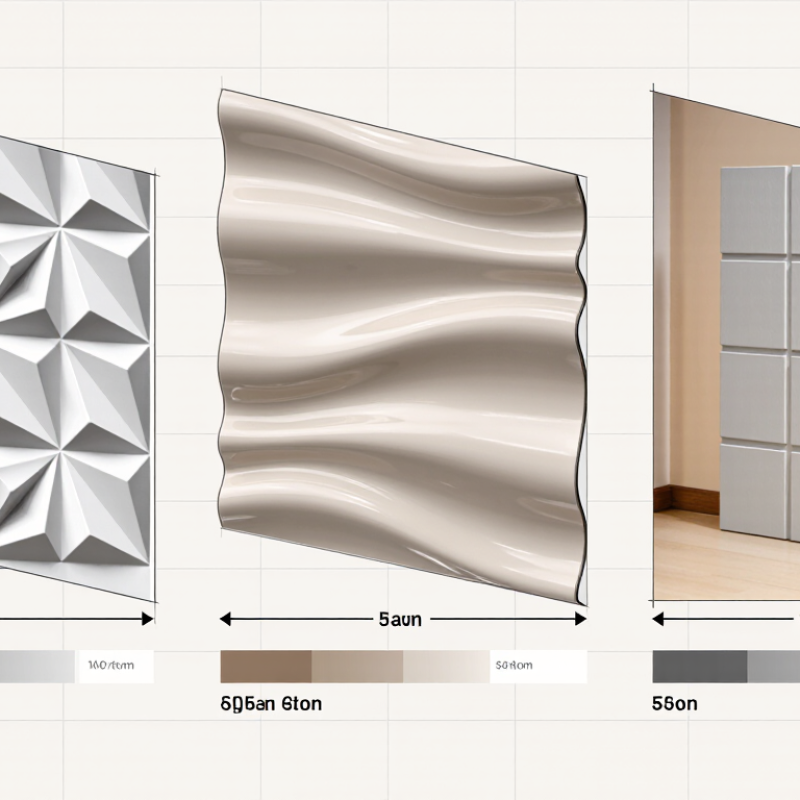
2026 Top 3D PVC Wall Panels for Global Buyers
What 3D PVC Wall Panels Are and How They Are Made
3D PVC wall panels are interior wall coverings with raised patterns that create visible depth and shadow. They are typically made from polyvinyl chloride, shaped into designs such as narrow ribs, waves, or geometric blocks. They are lightweight and can be easier to handle than many solid wall materials. The surface finish and panel thickness vary by product, so appearance alone cannot confirm quality.
Manufacturing commonly begins by blending PVC resin with colorants and processing additives. The mixture is heated and shaped through an extrusion line or pressed into a patterned mold, depending on the design. As the material cools, it holds its surface texture. Workers then trim panels and check details such as edges, color consistency, and dimensions. Small details matter. The process is not flawless; slight differences can appear between production batches, especially in color or finish.
Tips: Request a physical sample and compare it under your room’s lighting. Check the product specifications for thickness, installation method, and cleaning guidance. Also inspect corners and panel edges, where uneven finishing is easier to notice. A dramatic pattern may look appealing online, but feel too busy across a full wall. Test a small area before ordering for a large project.

In 2026, three-dimensional PVC wall panels come in several useful forms: geometric relief tiles, narrow slatted designs, and broad panels with stone- or wood-inspired patterns. Raised diamonds can add movement to a small reception area, while vertical ribs draw the eye upward in a low room. The effect depends on light. Side lighting makes shallow ridges look sharper.
Texture changes both appearance and upkeep. Matte finishes soften reflections and can disguise minor surface marks; glossy finishes brighten darker rooms but show fingerprints more readily. Wood-grain and stone-look patterns offer visual warmth without the weight of natural materials. Still, printed patterns vary between production runs, so check multiple panels together before approving a large order. A single sample can be misleading.
Design choices should account for installation, not just photographs. Compare panel thickness, edge joints, fixing methods, and the condition of the wall behind them. PVC can expand with heat, so installers should follow product-specific spacing guidance, especially near windows or warm equipment. “Water-resistant” does not mean every seam is waterproof. Ask for applicable fire-performance and UV-resistance documentation for the intended setting. A bold relief may look striking online, yet feel busy across an entire wall. Samples in the actual room help reveal that mismatch.
Three-dimensional PVC wall panels combine low weight with raised patterns that add depth without heavy masonry. Their surface is generally easy to wipe, and many options tolerate everyday splashes better than untreated plaster. Performance still depends on panel thickness, joint design, and installation quality. Check the product’s technical sheet rather than judging by a small sample. That matters. In a humid room, sealed edges and a dry, stable backing help limit moisture getting behind the panels. PVC can soften or discolor with excessive heat or prolonged direct sunlight, so keep panels away from hot appliances and test samples near bright windows. A glossy white finish may look slightly clinical under cool LEDs; view it in the actual room before ordering.
Common applications include bathroom walls outside direct-spray zones, kitchen splashbacks, laundry rooms, shop interiors, and reception areas. Textured panels can create a focal wall behind a counter or bed, while lighter designs suit corridors where bulky finishes are impractical. They can also help refresh a dated room with less demolition, though uneven walls may still require preparation. Installation is not always as simple as it appears. Leave suitable expansion space, use compatible trims and adhesives, and follow the manufacturer’s guidance for the substrate. For large projects, request samples from the same production batch; shade and texture can vary slightly.
Comparing 3D PVC wall panels for a global project starts with the room, not the catalog photograph. A deep pattern can look dramatic in a showroom, yet cast hard shadows under narrow corridor lighting. Request full-size samples and inspect them beside the actual light source. Small details matter.
Check panel thickness, relief depth, edge straightness, and the consistency of the joining system. Lay several pieces together on a flat floor; uneven seams often appear only across a wider run. For humid or warm sites, ask suppliers for documented dimensional-stability data and test a sample under realistic temperature changes. A label alone is not evidence.
Compare installation requirements, cleaning instructions, replacement availability, and packaging protection alongside price per square meter. Panels may travel thousands of kilometers, so corner damage, moisture exposure, and shade variation between batches deserve attention. Confirm that quoted dimensions, surface finish, and carton quantities match the project schedule before ordering. One easy-to-miss detail is trimming around outlets and uneven walls. That changes waste. Ask for a trial installation using local tools and labor conditions. It may look less polished than the sample board, but it is more useful.
Choosing 3D PVC wall panels for an international project takes more than comparing photographs. Check panel length, width, thickness, weight, and usable coverage per carton. Confirm whether measurements include the locking edge. Request a physical sample to inspect the embossed pattern, color, joint fit, and surface finish under natural light. Small differences can look obvious across a large wall. Ask suppliers to state acceptable production tolerances in writing.
Tips: Compare samples with the stated specifications. Ask for current test reports relevant to your destination, including fire-performance or emissions documentation where required. Verify that reports identify the tested product and match its construction. A logo alone is not proof. Keep it simple.
Before placing a bulk order, confirm installation requirements, compatible adhesives or fasteners, and cleaning guidance. Check how the panels are packed; crushed corners and scuffed finishes can create avoidable losses. Request carton dimensions, gross weight, production lead time, and a written order schedule. For compliance, requirements vary by market and building use, so confirm them with the importer or a qualified local adviser. Do not assume one certificate applies everywhere. One imperfect but useful step is ordering a small trial batch: it may reveal color variation or installation issues that a single sample cannot. Keep approved samples and written specifications for comparison during inspection.
Use this checklist to compare 3D PVC wall-panel offers. The specification ranges below are indicative examples, not universal industry standards; confirm the project requirements, applicable local codes, and product-specific test evidence before ordering.
| Checklist Area | What to Specify or Check | Indicative Data or Requirement | Buyer Verification |
|---|---|---|---|
| Panel dimensions | Panel length, width, thickness, and usable coverage per piece | Common product formats vary by supplier; request exact dimensions in millimetres and the net coverage after joining. | Compare a dimensioned drawing with the sample. Confirm tolerances and whether measurements include interlocking edges. |
| 3D profile | Pattern name or drawing, relief depth, repeat, and orientation | Relief depth is design-specific. Specify the measured projection in millimetres and identify the direction of the pattern repeat. | Review a full-size sample or installation mock-up under the intended lighting; confirm pattern alignment across panel joints. |
| Material and construction | PVC formulation, panel structure, surface layer, and any backing or reinforcement | Request a written construction description. “PVC” alone does not define resin composition, additives, panel structure, or surface finish. | Match the approved sample to the technical data sheet and purchase specification. Ask the supplier to disclose material changes. |
| Weight and handling | Mass per panel and mass per square metre | Require declared values for the offered size and construction; do not compare panels by thickness alone. | Check the data sheet and, where needed, weigh a representative sample. Use the confirmed values for freight and installation planning. |
| Surface and colour | Colour reference, gloss level, texture, and surface protection | Specify a physical colour standard or approved sample and state whether the finish is matte, satin, or gloss. | Approve a production-representative sample. Confirm colour variation allowances between batches and cleaning-product compatibility. |
| Dimensional quality | Length and width tolerances, flatness, edge quality, and joint fit | Agree numerical tolerances in the purchase contract; there is no single tolerance suitable for every panel design or installation. | Use an agreed sampling plan to inspect production. Check panel fit, visible warping, damaged edges, and consistency of the 3D profile. |
| Fire performance | Required reaction-to-fire classification for the installation location | Requirements depend on the country, building type, and use. Examples of different systems include ASTM E84 in the United States and EN 13501-1 in Europe; results are not interchangeable. | Obtain a valid report for the exact product construction and finish from an appropriate laboratory. Confirm the classification is accepted by the project authority. |
| Chemical and emissions requirements | Substance restrictions, indoor-air criteria, and market-specific declarations | Check applicable rules for the destination and intended use. REACH obligations may apply to articles placed on the EU market; VOC emission requirements vary by market and project. | Request current declarations and relevant test reports tied to the offered product. Do not treat a general “eco” claim as compliance evidence. |
| Product suitability | Interior or exterior use, humidity exposure, temperature limits, and cleaning method | Use only within the manufacturer’s documented conditions. A product described as water-resistant is not automatically suitable for continuous water exposure or exterior use. | Confirm installation location, substrate, adhesive or fixing method, expansion provisions, and maintenance instructions in writing. |
| Installation system | Joint design, trims, corners, adhesives, mechanical fixings, and substrate requirements | Request a complete installation detail showing the panel, joints, perimeter, and compatible accessories. | Confirm accessory availability, required tools, installation sequence, and who is responsible for substrate preparation. |
| Quality management | Factory inspection process, batch identification, and change control | Ask how dimensions, appearance, and packing are checked. A quality-management certificate such as ISO 9001 concerns a management system and does not by itself certify panel performance. | Request inspection records for the order and confirm that the production batch can be traced to the approved specification. |
| Packaging and transport | Protection against abrasion, impact, moisture, and edge damage | Agree the packing method, pieces per carton, carton dimensions, gross weight, pallet configuration, and container-loading plan. | Review package photos or a packing specification. Confirm shipping marks, export documents, and whether the packaging meets the route’s handling needs. |
| Commercial sourcing | Minimum order quantity, lead time, payment terms, and delivery responsibilities | Obtain a dated quotation stating quantity, currency, production lead time, quotation validity, and the named Incoterms® rule with place and year. | Compare offers on the same specification and delivery basis. Clarify inspection rights, defect remedies, and responsibility for freight and insurance. |
| Sampling and order approval | Sample stage, approval record, and acceptable production variation | Approve the panel profile, colour, finish, dimensions, and packaging before mass production. | Keep a signed or otherwise traceable reference sample and attach the final technical specification to the purchase order. |